
A Step-by-Step Guide for Citizens
When elected officials violate the public trust, Florida law gives citizens a powerful tool to hold them accountable: filing an ethics complaint. The process is more straightforward than many people think—and it plays a critical role in maintaining transparency and integrity in government.
Ethics complaints in Florida are handled by the Florida Commission on Ethics, an independent body responsible for investigating alleged violations of the state’s ethics laws by public officials, including county commissioners, city council members, and other elected leaders.
What Qualifies as an Ethics Violation?
Before filing, it’s important to understand what kinds of actions may constitute a violation under Florida law (primarily Chapter 112, Part III, Florida Statutes). Common examples include:
- Misuse of public position for personal gain
- Using government resources (staff, equipment, or property) for private business
- Conflicts of interest in voting or decision-making
- Accepting prohibited gifts
- Disclosing or using confidential information improperly
If an elected official is blending their public role with private interests—or using taxpayer-funded resources for personal benefit—you may have grounds for a complaint.
Step 1: Gather Specific Facts and Evidence
The most effective complaints are based on clear, factual information. Before filing, collect:
- Dates, times, and locations of the alleged misconduct
- Names of individuals involved
- Documents, emails, photos, or other supporting evidence
- A clear explanation of what happened and why it violates ethics laws
Avoid speculation or opinions—focus strictly on verifiable facts.
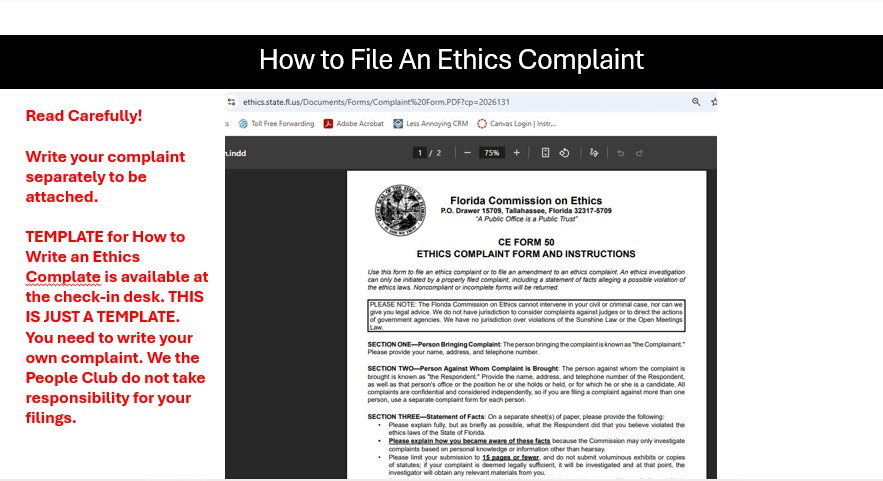
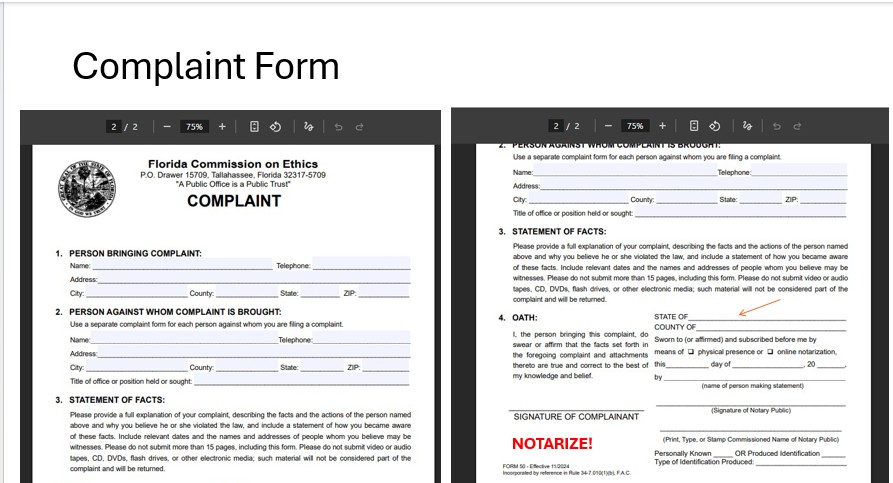
Step 2: Complete the Official Complaint Form
You must use the official complaint form provided by the Florida Commission on Ethics. Key requirements include:
- The complaint must be in writing and signed under oath
- It must be notarized
- You must identify the official involved and describe the alleged violation in detail
Link to CE Form 50 to file the complaint
https://www.ethics.state.fl.us/Documents/Forms/Complaint%20Form.PDF?cp=2024430
Anonymous complaints are not accepted, so you must provide your name and contact information.
Step 3: Cite the Law (If Possible)
While not required, it strengthens your complaint if you can reference the specific law you believe was violated—such as:
- Misuse of public position (Section 112.313(6), Florida Statutes)
- Voting conflicts (Section 112.3143)
Even if you’re unsure, clearly describing the conduct is enough for the Commission to evaluate the issue.
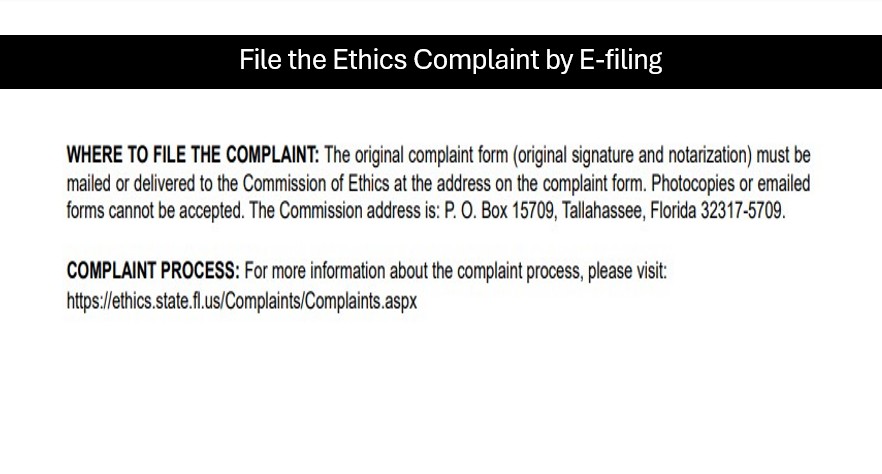
Step 4: Submit the Complaint
Once completed and notarized, submit your complaint to the Commission:
By Mail:
Florida Commission on Ethics
P.O. Drawer 15709
Tallahassee, FL 32317-5709
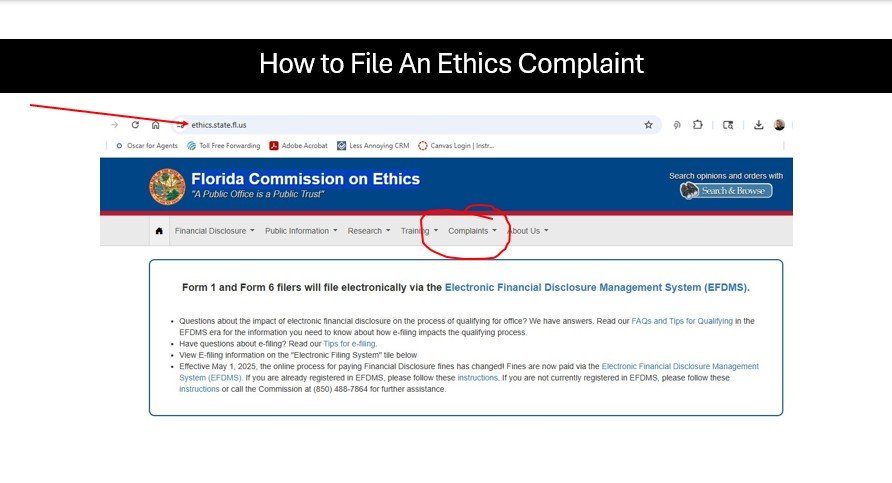
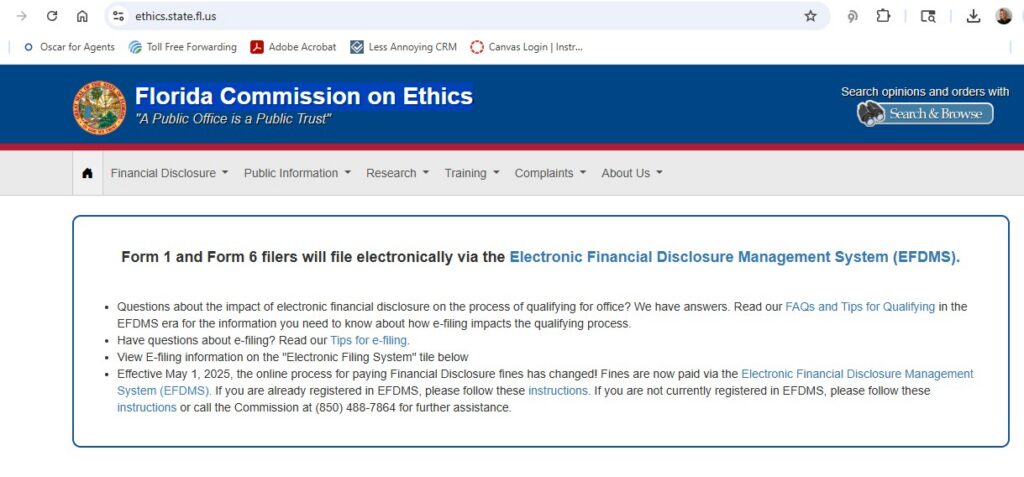
You can also find forms and instructions on the Commission’s official website. You cannot file this online. It must be mailed in. It is recommended that you sent it as Certified Mail or with Return Receipt.
Make copies for yourself of the complaint in its entirety, of the envelope post stamped at the post office, and of the receipt from the post office.
Step 5: What Happens After You File
The process typically unfolds in stages:
- Legal Sufficiency Review – The Commission determines whether your complaint legally states a possible violation.
- Investigation – If accepted, investigators gather facts and interview witnesses.
- Probable Cause Determination – The Commission decides whether there is enough evidence to proceed.
- Public Hearing (if applicable) – In some cases, hearings are held before a final decision.
If a violation is found, penalties may include fines, public censure, or recommendations for removal from office.
Important Tips for Filing
- Be precise and factual – Emotional language weakens credibility
- Stick to firsthand knowledge when possible
- Include documentation whenever available
- Follow all formatting and notarization requirements carefully
A poorly prepared complaint can be dismissed—even if the underlying issue is serious.
Why It Matters
Ethics laws exist to ensure that public officials serve the people—not themselves. Filing a complaint isn’t just about one incident; it’s about preserving accountability across all levels of government.
When citizens take the time to document misconduct and follow through with formal complaints, they help reinforce a system where transparency matters and abuse of power has consequences.
Final Thought: Civic Responsibility in Action
Government accountability doesn’t happen automatically—it depends on informed and engaged citizens. If you witness unethical conduct, taking action through the proper legal channels is one of the most effective ways to protect your community.
Filing an ethics complaint may seem like a small step, but collectively, these actions uphold the integrity of public service in Florida.
by Karina Schmitt
Disclaimer: This is not legal advise in any way, shape, or form. This information can be found on government websites. We the People Club is merely sharing what is available on government websites with you. We the People Club and its writers, club members or anyone else affiliated in any way with the Club is not responsible for what you do, what you file, and what the outcome is. That is entirely on you and you alone, and we will not be held accountble for what you decide to do with this information.