
Once upon a time, Punta Gorda Isles were, in fact, believe or not, affordable. It’s been a long time. In fact, we need to go all the way back to the early 1970s. Punta Gorda City Council Member Jeannine Polk spoke as the main speaker at the We the People Club on April 6, 2026, addressing topics such as the protection and preservation of Punta Gorda’s historical district, the outlandish rise in housing costs, the use of city assets to generate income, prioritizing residents first, and hiring strong leadership, including a new city manager and city attorney.
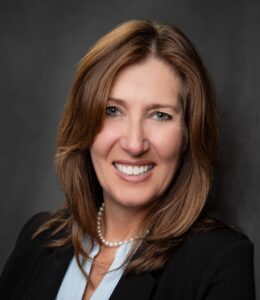
Council Member Polk took an educational approach to this meet-and-greet, as she recently announced her reelection campaign. She explained in detail the council-manager form of government and its structure. Understanding this structure is important, as it clarifies who council members ultimately work for—namely, the residents.
Fiscal Conservatism
Polk discussed the importance of supporting infrastructure projects, informing citizens of changes, explaining the reasons for increases in utility costs, expanding commercial development to attract businesses and create jobs, and providing updates on historical sites such as Punta Gorda City Hall.
The location of City Council meetings has changed. Previously, meetings were held at the Heritage Military Museum, but the rental cost was found to be unsustainable, prompting the City Council to explore more cost-effective options. The City had been paying $4,200 per month to hold meetings there. Changing locations proved to be a game changer for the City’s budget, as meetings are now held rent-free, prioritizing the interests of Punta Gorda taxpayers.
Punta Gorda Historical District Preservation
As Punta Gorda is well known for its historic district, this topic is often a focal point for both city- and county-level politicians. Polk emphasized the importance of protecting and enhancing the historic district. While some officials have engaged in heated debates over what preservation should look like, Polk took a straightforward approach, outlining specific preservation projects the City is proactively pursuing—many of which had previously been placed on the back burner by earlier councils.
She also discussed the importance of proper building setbacks for safety, pushing back against increased population density in the historic district, and addressing factors that contribute to flooding.
Encouraging New Business Development
As both the city and county continue to grow rapidly, Polk noted that residential expansion alone is not sufficient—especially if infrastructure does not keep pace and job opportunities lag behind. She discussed initiatives aimed at supporting growth through job creation, expanded commercial opportunities, and improved access to goods and services.
One objective is to maintain Punta Gorda’s historic aesthetic as new businesses are developed. Another is to meet community needs for emergency medical services. Rather than renovating the existing hospital—which is located in a flood zone and has sustained significant damage—the City Council opted to build a new hospital on the outskirts of the city. The proposed facility, with 80–100 beds, is considered sufficient to meet current needs, and its proximity to I-75 makes it a strategically sound location.
Both during construction and after completion, the hospital project is expected to create a substantial number of jobs in the area.
Using City Assets to Generate Income Through Taxation
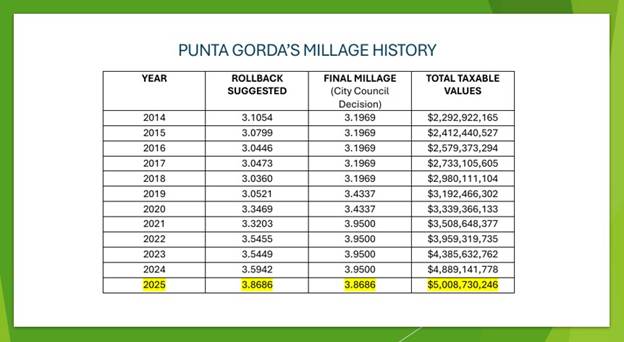
Polk explained how the millage rate has continued to rise over the years alongside increasing property assessments, contributing to an unsustainable cost of living. She demonstrated how these increases impact residents, noting that even when the millage rate appears unchanged, local governments still benefit from rising property values.
In simple terms, this relates to Truth in Millage (TRIM) notices. While officials may claim they are not raising the millage rate—and that may technically be true—they often fail to emphasize that rising property assessments result in higher overall tax bills.
Put another way, when calculating estimated property taxes in Charlotte County and Punta Gorda, homeowners typically pay around 1.5% of a property’s assessed value or purchase price annually. This is an important consideration for prospective homebuyers.
For example, if you purchased a home eight years ago for $300,000 and paid 1.3% in property taxes, your annual tax bill would have been $3,900. If that rate increases to 1.6%, your annual taxes rise to $4,800—an increase of $900. The question then becomes: has your income increased at the same rate?
Elected officials may campaign on the claim that they have not increased the millage rate. However, as Polk explained, this can be misleading if rising property values are not taken into account. For instance, if your home was valued at $300,000 in 2019 and taxed at 1.6%, you paid $4,800 annually. By 2024, even if the millage rate remained unchanged, a rise in assessed value to $425,000 would increase your tax bill to approximately $6,800 per year.
While rising property values may benefit those looking to sell, they can place a significant burden on residents who remain in their homes. Polk highlighted how maintaining the same millage rate does not necessarily prevent increases in the cost of living, particularly when property values surge. This dynamic benefits government revenue but can leave homeowners feeling financially strained.
Polk illustrated these trends in a chart, showing how much additional revenue is generated from homeowners over time.
What’s Next?
As a representative of the people of Punta Gorda, City Council member Jeannine Polk talked about the role she is playing in actively engaging in education the public and legislators about the impact the House proposals presented have on the public. As she indicated, nodding at FL State Rep. Danny Nix, who had spoken earlier in the meeting, this is where the state representatives have their work cut out for them.
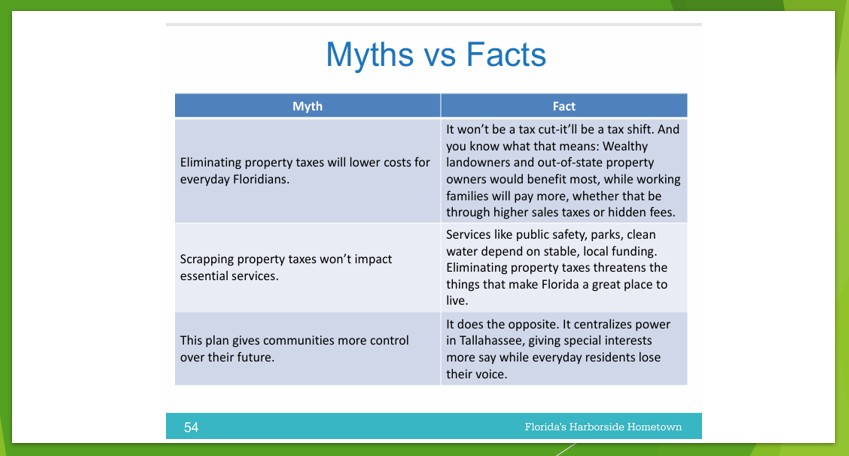
Polk discussed the importance of holding workshops to evaluate the level of service in the event that said proposals should pass into law along with educating the public about the effects. She is working to brainstorm with municipalities and engaging them in discussing ideas to offset revenue reductions. One of the fair budget decisions recently made by the City Council, so as to avoid financial suffering and digging in to the City’s reserves, was when they rightfully declined the request from the City’s police and their officers to get a 10% compensation increase, an outlandishly high increase which does not align with the average income-earner’s wage increase in the private sector. The Council declined their request and kept it at 4%, which is more than enough. her speech with an interesting and thought-provoking Myth vs. Fact, as seen below, that the reader ought to consider.
By Karina Schmitt
Watch the video in full from the meeting HERE. Like, Subscribe and Share our YouTube Channel.
Note: the illustrations in this blog are from Jeannine Polk’s presentation and published with her consent.