
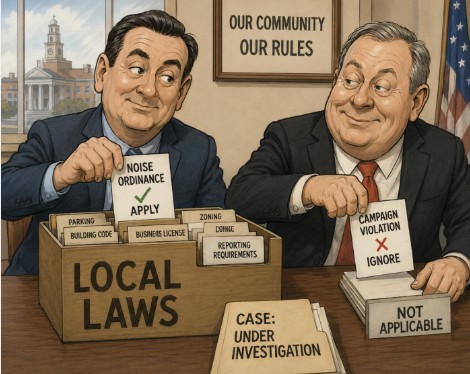
Concerns about fairness and consistency in leadership decisions can quickly erode public trust—especially when policies appear to be applied unevenly.
In recent discussions, attention has been drawn to actions taken by Joseph Tiseo in relation to a situation involving Christopher Constance. Observers have noted that Policy #3.45 was reportedly applied in this case, while questions remain about whether other relevant policies—such as #3.33 and #3.53—were fully considered.
This has led some to ask whether all applicable rules are being enforced consistently, or whether discretion is being applied in ways that are not fully transparent. In any governance structure, the selective use of policies—even if unintentional—can create the perception of bias or favoritism.
It’s important to be clear: without full access to internal deliberations, documentation, or official explanations, outside observers may not have the complete picture. There may be procedural, legal, or contextual reasons why certain policies were prioritized over others.
However, the situation highlights a broader issue: accountability frameworks work best when decisions are clearly explained, especially when multiple policies could apply. Public confidence depends not only on fairness, but also on the appearance of fairness.
If stakeholders feel that policies are applied inconsistently, it can prompt calls for:
Greater transparency in decision-making processes
Clear documentation of how policies are interpreted
Independent review mechanisms to ensure accountability
Ultimately, situations like this underscore the importance of consistent governance practices. Whether or not concerns are substantiated, they present an opportunity for leadership to clarify processes and reinforce trust.
By Blog Contributor Thomas Conti