
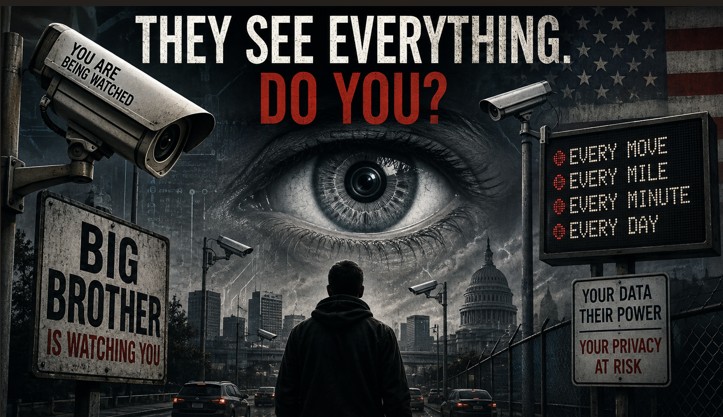
Walk through almost any American community today and chances are you’re being watched.
At intersections, neighborhood entrances, shopping centers, parks, and along major highways, cameras quietly record the movements of millions of Americans every day. License plate readers, traffic cameras, facial recognition systems, and privately owned surveillance networks have become so commonplace that many people no longer notice them.
The question is not whether surveillance exists.
The question is whether we have become too comfortable with it.
Today, more than 94,000 communities and locations across the United States use automated license plate reader (ALPR) technology or similar camera systems to capture vehicle information. Florida alone has become one of the nation’s largest users of these surveillance networks, with countless cameras installed by state agencies, local governments, law enforcement, and private organizations working in cooperation with public authorities.
Government officials often assure the public these cameras exist only to catch criminals and recover stolen vehicles. Few people object to using technology to solve serious crimes.
But history teaches an important lesson: powers granted to government in the name of security often expand beyond their original purpose.
The Fourth Amendment to the United States Constitution declares:
“The right of the people to be secure in their persons, houses, papers, and effects, against unreasonable searches and seizures, shall not be violated…”
The Founders understood that liberty cannot survive when government possesses unlimited power to monitor the daily lives of its citizens.
Supporters of widespread surveillance argue that people who have done nothing wrong have nothing to fear.
That argument misses the point.
The Fourth Amendment was never intended to protect only criminals. It was written to protect ordinary, law-abiding citizens from unnecessary government intrusion.
Every trip to church.
Every visit to a political meeting.
Every doctor’s appointment.
Every stop at a gun store.
Every visit to a journalist, attorney, or counselor.
Should government agencies be able to compile detailed records of our daily movements simply because technology now makes it possible?
Many surveillance systems retain data for weeks, months, or even years. That information may be shared among agencies, searched later, or combined with other databases to create remarkably detailed profiles of individuals who have never been suspected of committing a crime.
Technology has outpaced the constitutional debate.
Americans should be asking difficult questions.
Who owns this data?
How long is it stored?
Who has access to it?
Can it be sold?
Can it be hacked?
Can it be used for purposes beyond solving crimes?
Perhaps the most troubling question is this: What prevents today’s limited surveillance from becoming tomorrow’s comprehensive tracking system?
The Founders did not fight a revolution merely to replace one form of unchecked government power with another.
Public safety and individual liberty are not mutually exclusive. Law enforcement can investigate crime while respecting constitutional safeguards. Warrants, judicial oversight, transparency, and strict limits on data collection help ensure that surveillance remains targeted rather than indiscriminate.
Freedom is rarely lost all at once. More often, it is surrendered one small compromise at a time, each justified as reasonable and temporary.
The cameras are already here.
The technology will only become more sophisticated.
The real question is whether Americans will insist that constitutional protections keep pace with technological advancement—or whether future generations will inherit a society where being watched has become the price of simply living free.
Liberty requires vigilance—not only against criminals, but also against the gradual erosion of the constitutional rights that define America.
A Call to Action
If you believe the Constitution still matters, now is the time to make your voice heard.
Contact your city council members, county commissioners, state legislators, your governor, and your members of Congress. Tell them that you oppose the ever-expanding surveillance state and demand that automated surveillance cameras—including license plate readers and traffic enforcement cameras that collect vehicle information—be removed from our streets unless they are subject to meaningful constitutional safeguards and public oversight.
Ask your elected officials these simple questions:
- Why are law-abiding citizens being tracked wherever they drive?
- How long is this data being stored?
- Who has access to it?
- Is it being shared with private companies, other government agencies, or third parties?
- What independent oversight exists to prevent abuse?
- How can citizens verify that their personal travel history is not being misused?
The uncomfortable truth is that most Americans have little or no control over how this information is collected, stored, shared, or analyzed once it enters a government or third-party database. Data collected for one purpose today can be repurposed tomorrow. Databases can be expanded, policies can change, and information can be shared in ways the public never anticipated.
Our Founders did not write the Fourth Amendment to protect only our homes—they wrote it to protect our freedom from unreasonable government intrusion.
Once a surveillance network is built, history shows it is rarely dismantled. More often, it grows.
Don’t wait until every movement you make is permanently recorded and cataloged before speaking up.
Demand transparency.
Demand accountability.
Demand that your constitutional rights be respected.
Because a free people should never have to accept constant surveillance as the price of living in a free society.
The Constitution is only as strong as the citizens willing to defend it.