
At a time when Charlotte County residents are already burdened by excessively high utility rates, it now appears that four of the five county commissioners are preparing to impose yet another financial hit on households that are already stretched thin.
For working families, seniors, and those on fixed incomes, these decisions are not abstract budget adjustments—they translate directly into less money for groceries, housing, and basic necessities. The question residents must ask themselves is whether they are willing to continue absorbing these increases without meaningful justification or accountability.
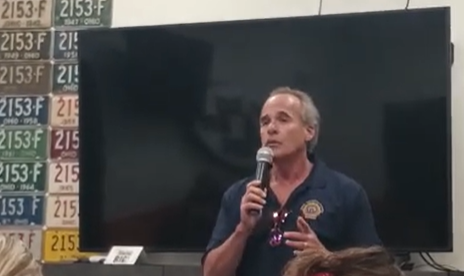
Concerns about an impending utility rate hike were publicly raised by John Fleming, candidate for Charlotte County Commissioner, who warned of what We the People Club would call “a looming utility bomb” during his remarks at today’s Trump Club meeting. Fleming urged residents to make their voices heard by attending…
the Charlotte County Commission meeting tomorrow at 9:00 a.m. at 18500 Murdock Circle in Port Charlotte,
… emphasizing that public participation may be the only remaining check on decisions that once again reach directly into the pockets of taxpayers.
In other words, if you don’t speak up now and immediately about this, your silence will support those of the county commissioners who could care less about the financial impact that raising the utility rates – AGAIN – will have on the people… on you and your family.
Click HERE for the YouTube speech by John Fleming that We the People Club documented.
When county commissioners approve increases in utility rates, power costs, and other essential services, those local decisions do not occur in a vacuum—they increasingly mirror a broader global policy direction that critics argue aligns with the framework of the United Nations’ Agenda 2030. Under this critique, escalating costs tied to energy transitions, environmental compliance, and centralized planning are seen as mechanisms that expand government control over basic necessities while placing a disproportionate burden on working families and fixed-income residents.
As costs rise, those with wealth can adapt, invest, or relocate, while lower-income households are pushed closer to dependency, debt, or displacement, thereby deepening the divide between rich and poor. From this perspective, when local officials raise utility rates during an affordability crisis, they are not merely managing budgets—they are advancing policies that accelerate economic stratification and erode individual autonomy. Whether intentional or not, such actions reinforce a system in which everyday people lose financial breathing room while power and resources become increasingly centralized, a result that stands in direct conflict with the duty of local leaders to protect their constituents from further economic harm.
What makes this situation even more troubling is the timing and direction of the legislative push itself: just as residents are grappling with rising utility rates and an already crushing cost of living, State Representative Vanessa Oliver, with the support of State Representative Danny Nix, filed legislation to remove control of Punta Gorda’s utilities and transfer it to Charlotte County.
It is unethical and indicative that these elected officials do not represent the people – they represent big government.
To many observers, this does not look like responsive, local governance—it smells like centralization of power, distancing decision-making from the people most affected by it. Centralizing essential services such as water and utilities under larger governmental bodies reduces local accountability, limits community oversight, and makes it easier to impose uniform rate increases with less resistance.
Critics argue this mirrors the broader global push embedded in the United Nations’ Agenda 2030 framework, which emphasizes regional governance, consolidation of infrastructure, and top-down management in the name of efficiency and sustainability. When local control is stripped away at the same moment costs are rising, it raises a serious and uncomfortable question: is this truly about serving residents—or about advancing a centralized model of governance that benefits those with power while ordinary citizens pay the price?
Send us your comments or post them. Subscribe to our YouTube channel for unfiltered news and reports @wethepeoplecc
We are no longer represented by those that we elect to speak and ACT on our behalf. Misrepresentation should lead to termination immediately. We can represent ourselves without the bureaucracy of a middle man. All votes for ANY changes should be left up to WE THE PEOPLE. Direct communication is the key.
I hope everyone knows that Punta Gorda adds a 25% surcharge to your water/sewer bill if your home is outside the city limits. Years ago, city governments had their lobbyists go to Tallahassee and whine that it cost them more money to serve customers outside the city limits. Even though they had no data, state legislators allowed them to add a surcharge of up to 25% for customers not inside the city limits. And guess what they all did?