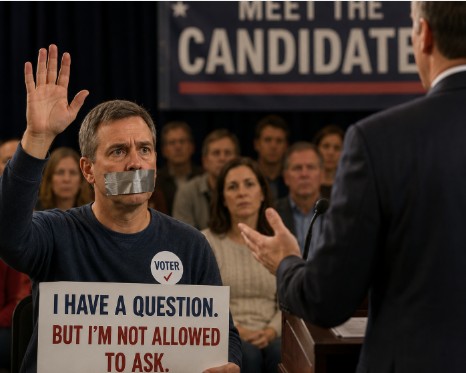
Freedom of speech is more than the right to speak; it’s the opportunity to ask questions and receive answers from candidates running for office. In a representative republic, informed voters depend on open dialogue to evaluate those seeking public office. In many countries, freedom of speech is limited or denied. In the United States, we pride ourselves that we have the Bill of Rights that gives us freedom of speech, at least on the surface.
But do we really have freedom of speech anymore? Or is the establishment – including those withing the Republican circles – killing slowly?
When voters are prevented from asking questions, whether through limited public access, controlled events, or the absence of public forums, an essential part of the democratic process is weakened and gradually destroyed. It’s a fact that citizens cannot make fully informed decisions if they are denied the opportunity to hear candidates explain their positions, defend their records, or address concerns.
This is not about ensuring “safety” of the candidate or not making the candidate feel uncomfortable with certain questions they don’t like to answer. Their job is to answer any questions the voters may have, and if they won’t, they are not fit for office. Period. End of story!
When candidates are running for office, whether it’s their first election experience or they are running for reelection, they must meet the voters and they must answer questions public. I’m talking about not allowing controlled events where the questions are given to the candidates beforehand. I’m talking about putting a hard stop to those candidate events where a club or organization is controlling what kind of questions can be asked “so we don’t offend or make the candidate feel they are being verbally attacked.” I am talking about allowing the public – voters – to ask unfiltered questions.
Likewise, when candidates decline to participate in debates, voters lose one of the most effective ways to compare ideas, leadership styles, and problem-solving abilities. Additionally, candidates who refuse to debate not only send a clear, undeniable signal that they are inapproachable and do not care about the average voter in their district. It sends a message that the candidate has lost credibility.
Do not vote for candidates who won’t debate or who wants controlled questions when meeting the voters. We have several in Charlotte County who hide behind this veil and go to great length to avoid accountability.
Debates challenge candidates to think on their feet, clarify their positions, and respond to differing viewpoints in real time. They are essential, crucial in fact, to vetting the candidate.
Healthy self-government depends on transparency, accountability, and the free exchange of ideas. If a candidate cannot handle being questioned, they have no place in public office, and they have no business representing the people.
Remember; elected officials work for us – the People – and must answer to us. It is not the other way around. We are the ones flipping the paycheck for the elected officials.
Open questions and public debate are not merely political traditions. They are essential tools that help voters separate fluffy campaign rhetoric from substance. They peel the layers of the onion and are intended to discover what this candidate that is being put on the spot is factually about.
It is not difficult to write the fluffy and often fake content on a campaign website and put up pictures of the candidate that show action. AI platforms can easily produce images, tweak images. Many candidates put up signs that says, “Firefighters Endorse.” We all like EMTs and firefighters, as they are the only first responders who truly are there to help when you’re hurt or something is burning, etc. So, to say you’re endorsed by them sounds great, right?
The fact of reality is that seeking endorsement does not mean that each and every one in that organization supports the candidate. It simply means that the head or board of the organization has been solicited by the candidate, often promised this that and the other in exchange for their perceived endorsement, while many of the workers within the organization may not vote for the candidate. It is used as a marketing tool solely for the purpose of convincing the voter to vote for the candidate. Money is often involved behind the scenes in these “support transactions.” It is deceptive to the voters.
Freedom of speech is not diminished only when voices are censored. It is also weakened when meaningful public dialogue disappears. An informed electorate requires more than campaign advertisements, flashy TV spots, prepared statements, and polished appearance. Any trained, coached, and well-funded political actor can learn lines, rely on billboards, and recite prepared statements to journalists. Half the time, these constructed interviews are designed to help the candidate instead of questioning them.
An example: Kim Amontree was interviewed by CCN recently, an interview done by teleconference, perhaps Zoom. Throughout the interview, the candidate sounded like she was reading prepared answers off a screen. Pay attention to the monotone tone in the subject’s voice. While on the surface it sounds like the subject being interviewed is “in control of the interview”, underneath the surface it’s constructed and designed to position the candidate as a power figure.
Consider interviews that are unscripted and unconstructed. These are conversational, impulsive, and serve to put the candidate on the spot, which is how you achieve genuine reactions and responses from the candidate.
When candidates avoids unscripted on-the-spot interviews, that is a huge red flag.
Debates and unfiltered, unprepared interviews requires access, accountability, and the willingness of leaders to engage with the people they seek to represent.
Think of it as a job interview because that is really what it is. The candidate is applying for a public office job, and you – the voter – must think of yourself as the hiring manager. The money – tax dollars – that the elected official will be responsible for when it comes to public spending is your money is for you to determine if the candidate may have your interest or not. Ask the question to yourself if you think that the candidate will be fiscally responsible, and do you think that they will spend your hard-earned money wisely. If you think that the candidate may become a big tax-dollar spender, do not vote for them. It is not uncommon for candidates to proclaim that they “support fiscal responsibility”. Of course, they will state that in their advertisement. No candidate will say on their postcard they mass mail to voters that they spend tax dollars irresponsibly like a five-year-old in a candy shop.
Remember, you are the hiring manager. Ask the hard questions. That is the reason that any meet-the-candidate event must allow the audience to ask questions from the audience. No compromise. If it does not allow questions from the audience, you should really question why the audience – the voters – are being silenced. Silencing the Voters Violates Our Rights!
Get ready for The We the People Podcast Show coming soon on our YouTube channel. https://www.youtube.com/@WethePeopleCC Subscribe now, and don’t forget to Like and Share.
By Karina Schmitt, Senior Blog Contributor.