
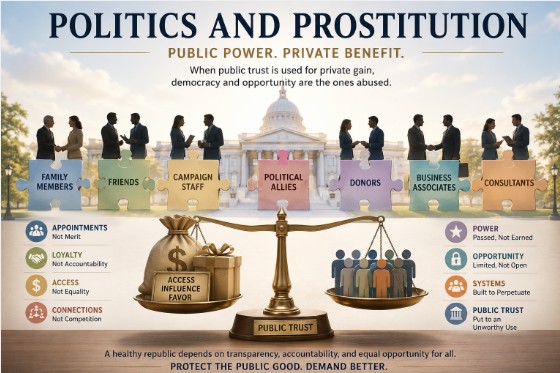
Politics was originally conceived as a form of public service. In the American republic, elected office was intended to be occupied by citizens willing to temporarily leave private life, serve their communities, and then return home. The office was never intended to become a career track managed by insiders, a family inheritance, or a reward bestowed upon members of a political network.
Across the country, voters are witnessing the emergence of political ecosystems that perpetuate themselves. Sometimes this takes the form of political dynasties, where sons follow fathers, daughters follow mothers, and spouses succeed one another in office. More often, however, it involves a broader circle of relationships. Friends, business associates, major donors, campaign staff, political allies, and favored appointees are groomed, mentored, and positioned for future opportunities. The goal is often not merely to elect a candidate but to preserve influence, maintain relationships, and ensure that power remains within a trusted network.
This is where the concept of political prostitution enters the discussion.
Using the word in its secondary sense—the state of being used in an unworthy or dishonorable way—the concern is not about individuals seeking public office. It is about the corruption of the purpose of public office itself. When candidates are selected, molded, packaged, and advanced primarily because they serve the interests of an existing political machine, public service risks becoming a commodity rather than a calling.
The office becomes something to be distributed. The candidate becomes a product. The voters become spectators to decisions that may have been made long before an election is held. In some cases, individuals are positioned for appointment rather than election, allowing political insiders to place trusted allies into positions of authority without requiring them to earn public support through open competition.
The issue is not whether a family member, friend, or business associate is qualified to serve. Many are. The issue is whether the political system increasingly rewards relationships over representation, loyalty over accountability, and access over merit.
By Karina Schmitt, Content Contributor
Follow us on Facebook