Communities across America are increasingly installing Flock Safety cameras with the promise of reducing crime and assisting law enforcement. While public safety is an important government function, citizens should carefully consider the constitutional and privacy implications of creating widespread surveillance networks that monitor the movements of law-abiding individuals.

Flock cameras are designed to capture vehicle information, including license plate numbers, vehicle descriptions, and travel patterns. Although supporters argue that these systems help solve crimes, the reality is that they collect data on thousands of innocent citizens who are not suspected of any wrongdoing. Every trip to work, church, a political meeting, a doctor’s office, or a friend’s home can potentially become part of a searchable database.
The Founders of the United States understood the dangers of government intrusion into private lives. The Fourth Amendment was specifically intended to protect citizens from unreasonable searches and government overreach. Americans have long expected to be secure in their persons, houses, papers, and effects without constant monitoring by authorities.
The concern is not simply how the data is used today, but how it may be used tomorrow. History repeatedly demonstrates that powers granted to government agencies tend to expand over time. Surveillance tools created for serious criminal investigations can eventually be used for purposes never originally intended.
Public safety and individual liberty should not be viewed as opposing goals. Communities can support effective law enforcement while still demanding strong protections for privacy, transparency, limited data retention, and constitutional safeguards. Freedom requires vigilance, and citizens should carefully examine whether constant surveillance is a price they are willing to pay for the promise of greater security.
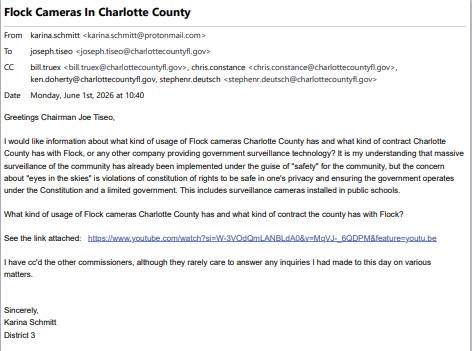
As residents become more aware of the growing use of surveillance technology, it is important to ask questions about transparency, accountability, data retention, and constitutional protections. Today, members of the Charlotte County Board of County Commissioners were contacted regarding the surveillance technologies that have already been implemented within Charlotte County and to seek clarification on the scope, purpose, oversight, and privacy safeguards associated with these systems. Citizens have both a right and a responsibility to understand how government is collecting, storing, and using information about their daily activities. An informed public remains the strongest safeguard against the gradual erosion of liberty.
Watch the video HERE about Flock camera community surveillance.
by Karina Schmitt, Admin and Blog Contributor