
When Silence Speaks Louder Than Words
A Reflection on Candidate Kim Amontree’s Refusal to Answer Voter Questions
On November 3, 2025, Candidate for Charlotte County Commissioner Kim Amontree addressed members of the We the People Club, outlining her campaign vision for Charlotte County. It was an opportunity for her to connect directly with engaged citizens, share her plans, and—most importantly—demonstrate the integrity and transparency expected of anyone seeking public office.
The evening was organized with structure and fairness. As is customary, the club provided Ms. Amontree with a list of questions at the meeting. Any questions not addressed during her presentation were to be sent to her by email, affording her five full days to respond—ample time for reflection and written reply.
Yet, despite this courteous and transparent process, Ms. Amontree declined to answer any of the questions.
The Sound of Evasion
In politics, as in leadership, silence can be far more revealing than words. When a candidate refuses to answer questions posed by the very people whose votes she seeks, it raises a fundamental concern: what is she unwilling to say—and why?
This was not a “gotcha” ambush or a hostile interrogation. These were the same fair, substantive questions posed to every candidate who stands before the We the People Club. Questions that matter deeply to the citizens of Charlotte County—questions about fiscal responsibility, integrity in office, growth and infrastructure, and whether candidates truly prioritize people over political ambition.
Refusing to answer is not simply a matter of “choosing not to engage.” It is a deliberate act of avoidance. It suggests either an unwillingness to be transparent, or a lack of confidence in one’s own positions. Neither bodes well for someone seeking to represent the public trust.
The Responsibility of Representation
Public office is not a platform for comfort—it is a crucible for accountability. Those who aspire to govern must be prepared to engage, to defend their ideas, and to face hard questions with composure and honesty.
To decline participation in that process is to forget what leadership demands. It is to dismiss the very foundation of representative government: that the people have a right to ask, and that their representatives have a duty to answer.
Ms. Amontree has served multiple terms on the School Board. With that tenure comes experience, but also responsibility. Experience should make one more prepared to engage—not more entitled to avoid scrutiny. At this stage in her career, she should understand that voters are not mere spectators in the political process; they are its rightful owners.
And when those voters—organized, informed, and respectful—extend an invitation to discuss the issues face-to-face, declining to respond does not demonstrate leadership. It reveals detachment.
The Question of Integrity
Integrity in leadership is not measured by the polish of one’s speeches, but by the willingness to be transparent when it matters most.
The We the People Club has presented a simple, consistent protocol: every candidate who speaks before the group is given the opportunity to address questions—either in person or in writing. This protocol ensures fairness, consistency, and accountability for all who seek to hold office.
For Ms. Amontree to disregard that process is not only a failure of courtesy—it is a breach of trust. It signals to voters that she considers herself exempt from the same expectations of transparency that others have met without hesitation.
When a candidate refuses to participate in the exchange of ideas, we are left to wonder: what does she fear? That her answers may not align with her record? That the truth may not fit the carefully managed image of her campaign?
One cannot champion “open government” while choosing silence when citizens ask questions. One cannot claim to serve “the people” while ignoring the very people who seek honest dialogue.
The Era of Empty Promises Is Over
We live in a time when voters are weary of polished talking points and rehearsed campaign lines. Citizens today crave authenticity, not performance. They demand clarity, not concealment.
The role of a public servant is not to preserve comfort—it is to uphold accountability. In this climate, refusal to answer questions is not a neutral act; it is a statement of disregard for the public’s right to know.
The citizens of Charlotte County deserve better than evasive politics. They deserve candidates who see questions not as threats, but as opportunities—to explain, to connect, to lead with conviction.
If a candidate cannot face tough questions before an election, how can voters trust her to face tough decisions after it?
Leadership vs. Careerism
There is a distinction—an important one—between leaders and career politicians.
Leaders welcome scrutiny. They understand that accountability sharpens credibility.
Career politicians, on the other hand, shrink from it. They prefer controlled narratives, safe applause, and selective appearances.
By refusing to answer, Ms. Amontree has signaled that she is more interested in preserving political comfort than in confronting public concern.
True leadership requires courage—the courage to say, “Here is where I stand,” even when that stance invites disagreement. Voters may not always agree, but they will always respect honesty. It is evasion that erodes respect.
Charlotte County stands at a pivotal point in its growth. This community needs representation that is transparent, responsive, and grounded in principle—not in self-preservation.
The Voters Are Watching
The We the People Club, and indeed the broader Charlotte County electorate, will not forget this moment. Silence has a memory.
In declining to respond, Ms. Amontree has made her choice. But the people will make theirs, too.
In the days ahead, the club will continue its mission to inform and engage voters. The unanswered questions will remain on record—because voters deserve to know what their candidates were asked and what they refused to answer.
And while Ms. Amontree has, for now, chosen silence, the conversation is far from over.
The Next Step
In the spirit of fairness—and in the unwavering belief that the voters of Charlotte County deserve a transparent comparison—the We the People Club will be extending an invitation for a debate between Ms. Amontree and her opponent later in the campaign season.
It will be a public forum. No prepared scripts. No selective silence. Just questions—and answers. Whether Ms. Amontree chooses to accept that invitation will tell the voters far more than any campaign slogan ever could. Until then, we wait. Because in democracy, waiting for answers is not the same as accepting silence.
We the People Club look forward to welcome Candidate for Charlotte County Commissioner John Fleming on December 1, 2025 and Incumbent Charlotte County Commissioner (date to be determined soon).
These are the questions that Kim Amontree running for Charlotte County Commissioner refused to answer. There is no question that should be too difficult to answer. Ms. Amontree was reelected in August 2024 as School Board Member for her third term (4 years). She filed to run for Charlotte County Commissioner earlier this year, less than a year after her reelection to the school board.
EMAIL TO KIM AMONTREE ON 11/4/2025:
Dear Kim,
Thank you for speaking at yesterday’s We the People Club meeting. Here are the remaining questions. Please email the answers under each questions, as they will be presented on our blog as Questions and Answers one by one. There will be a reference in the blog to the questions already answered and a link to the unedited video. We will schedule a debate between the candidates closer to the election and look forward to your participation.
Questions:
- What would success in this position look like for you personally—and for the people you represent?
- What is the agreement with FDOT/County for Traffic where these developments are appraised (referencing the developments that were discussed in the meeting)?
- What personal sacrifices are you willing to make for the good of your constituents?
- How do you define “servant leadership,” and how would you demonstrate it in this role? Please provide example of how you have provided “servant leadership” in your current public office role.
- In your current elected position, what is the percentage of your salary that you have donated to charity, and which charities have you donated to? Can you document your donations for us, and would you be willing to pledge to donate all your salary and pensions that this job comes with to charity, and which charities locally would you donate it to?
- At the Trump Club on August 12, you said that “all incumbent races are rigged.” You were the incumbent in that race for the school board in 2024. If the election results are rigged, and you knew about it, why did you not demand an investigation and/or resign to ensure election integrity. Was the election stolen in Charlotte County? (you stated that at yesterday’s meeting as well that “incumbent races are rigged”)
- What measures would you put in place to ensure transparency and accountability in your own office?
- What kind of programs do you plan to implement that will benefit new small businesses, cut the red tape, and help new small businesses in the start-up phase – that is within the first two years? Will you support government-backed new small business loans to get new businesses started? SBA restricts lending to those who can provide 2-3 years of business tax returns or collateralize their homes.
- The governor is working, as is the President, to eliminate property taxes. Will you work to eliminate property taxes too?
- You mention on your campaign site that you will fight for “attainable housing”. As rising cost of living and housing cost is on most people’s minds, what are you going to do to bring down the housing cost? How do you differentiate between attainable housing and affordable housing? With your plan, will we see housing costs brought back to where they used to be about 10 years ago when it was truly affordable and property taxes were reasonable? What is your plan and how do you plan to execute it, given you don’t have full control over the other commissioner’s voting on these matters? Please elaborate on your ideas to create jobs and cut excessive government regulations that are counterproductive to small business growth.
- What is your professional background in development of multifamily use and housing developments? Have you worked in the industry?
- On your campaign website it states “ensuring that illegal immigrants who commit crimes are held accountable—not released back onto our streets.” Are you only concerned with illegals who commit crimes or do you support working with law enforcement also in our county to identify, find, and detain anyone who has entered the country illegally and lives or works in this county and turn them over to law enforcement and ICE, ensuring that Charlotte County will never be a sanctuary county? Will you support this to include minor illegal immigrants attending school in Charlotte County too?
- Records show that you have missed 14% of your school board meetings and missed key votes on taxes and safety. Can you explain what a future for Charlotte County might look like if you are elected when your absence rate is that high? How are you going to be available to listen actively to the residents and voters in Charlotte County if you’re not present all the time? You speak about fiscal conservatism and being ready to transform Charlotte County as a commissioner, but records show that while you have been a school board member, you have raised the school taxes by 9.2%. How does fiscal conservatism align with your vision for Charlotte County when you support raising taxes?
- 12 out of the 13 original colonies had in their constitution the requirement to serve in government one had to be a Bible-believing Christian. What is your perspective on that and how have you demonstrated that you are an elected official who is a Bible-believing Christian?
- You have questioned the historical value of Port Charlotte middle school, but it has been considered by the FL Department of State and they believe it would pass nomination for the national register of historic places. Please explain.
- You have stated that you plan to spend over $100 million on a new middle school. Can you explain how that aligns with fiscal conservatism?
- On you campaign website, you state that “Politicians should serve, not stay. Florida imposes term limits on the Governor, Cabinet officers, and State Legislators—County Commissioners should be held to the same standard. Kim will fight to enact term limits, ensuring fresh leadership and stopping career politicians from entrenching themselves in power.” If you support term limits, why did you run for a third term for school board when the position could have been fulfilled by another candidate who ran against you?
- How do you handle criticism, especially when it comes from people who supported you?
- Who do you seek counsel from when you have to make difficult decisions—and do you actually listen to differing opinions? Do you listen to opposing opinions from constituents for a well-rounded understanding of the issues?
- According to sources that We the People spoke to, you stated at a neighborhood meeting after the 2024 hurricane season that you could open the Charlotte Harbor beach complex in two weeks. How do you propose to accomplish this when it takes 18 months to get the core of army engineers out there first to inspect it, per sitting officials? (This question was partially answered. Please provide details)
- What professional and academic background do you have, and what kind of work experience in the private sector do you have relative to zoning and land use that qualifies you for the position for which you’re running? What kind of job experience do you have related to land use, water, sewage, and septic systems?
- You were reelected in 2024 as school board member and committed to serve for 4 years, but now you’re seeking other opportunities as a commissioner, which means your focus has shifted away from education. Should you not complete your commitment to education before you seek other opportunities? Why did you lose interest in your elected position as school board member only months after you were reelected for a 3rd term? (A similar question came up elaboration on this very important question about why you have changed your focus less than a year after reelection is critical. Please elaborate with focus on your career motivations and not what people encouraged you to do). A second person had asked this question: You were just reelected to school board last year for a 3rd term. Within about 6 months you filed to run for county commissioner. Why would you run for reelection when you knew that you did not have intentions of staying in the position for the full term, but already had plans to run for commissioner? Would it not be fair to say that your efforts are divided? (since we had two similar questions, it is clearly something that people are seeking answers for)
- Can you describe a time when you admitted you were wrong in public? What did you learn from it?
Subscribe to our YouTube channel and see the entire speech Kim Amontree gave on November 3, 2025.
EMAIL FROM KIM AMONTREE.
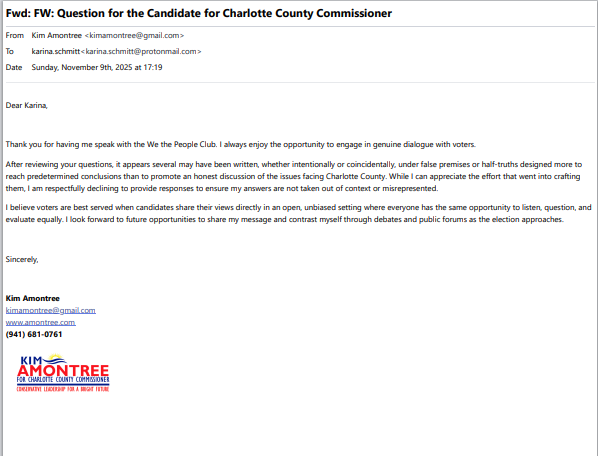
We the People Club supports honesty and transparency. Thus, the communication is posted here, so there can be no questions or speculations about how the candidate responded to the questions we sent her.
The next Meet the Candidate meeting will take place on December 1, 2025 at Mission BBQ in Port Charlotte, FL at 7:00 PM. RSVP please to [email protected].
WOW!!!!! I am impressed! This should be done to ALL of the County Commissioners at this point!!! I have attended several public meetings and I must say…. Their dirty work has already been carved out in STONE before we the people get any notifications!!!! Totally Wrong!!!
Question number 5 asks who or to what charities a person donates to.
Is this your business? Is it anyones?
I ask for Gods blessings on my gifts, give anonymously, the person receiving the gift may thank God, not me.
Question number 14 shows that this is a not so thinly veiled atempt to make religion an integral part of your political agenda.
I don’t want religion to be part of my government, but even more, I don’t want government to have any part in my religeon.
Than you,
Larry Mckenzie
That’s a pretty daunting task to answer all those questions. Some are great questions, some answers should be revealed if she has submitted a detailed resume, and some are a bit over the line…too personal, too general, or not yet determined as a new candidate for the office. She should respond, yes, but I wouldn’t answer them all if I was running either.