
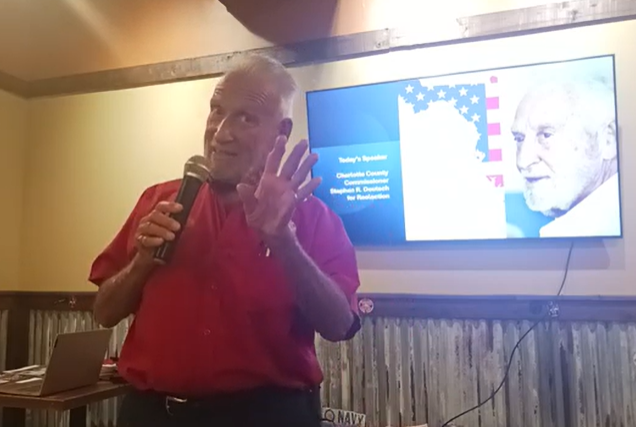
On January 7, 2026, Charlotte County Commissioner Stephen R. Deutsch, who is running for reelection, met with the We the People Club and an exceptionally active audience to present his campaign focus points (see below), share his background, and engage in an extensive question-and-answer session. More than 40 questions – the largest number of questions so far that has been asked at our Club meetings – were asked by both Club members and attendees, and every question was answered during the meeting, making follow-up submissions unnecessary.
Due to the length of the event, the meeting was recorded and divided into four video segments, which will be posted on the Club’s YouTube channel as Parts 1, Part 2, Part 3, and Part 4.
Part 1: Background, Public Service, and Grassroots Engagement
In Part 1, Commissioner Deutsch focused primarily on his history and background, addressing several of the Club’s initial questions. He provided a thorough overview of his career as an elected official in both Rhode Island and Florida, emphasizing decades of public service and civic involvement.
Deutsch explained how he became involved in local politics in Charlotte County and underscored the importance of people-centered campaigning over expensive advertising. He spoke in favor of old-fashioned door-knocking, grassroots engagement, and direct communication with voters. He emphasized that he has never missed a session or a vote and makes himself accessible to residents regardless of the issue—whether it involves a pothole, a fence dispute, land-use concerns, or broader matters that impact the entire community.
Budget Accountability and Protecting Fixed-Income Residents
Deutsch strongly criticized the Charlotte County Commission for rejecting his proposal to eliminate certain budget items that, according to his analysis, could have reduced the county budget by approximately $10 million. He reiterated that he was the only commissioner to vote against the most recent budget, while the remaining commissioners supported measures that included utility rate increases for residents.
Deutsch stated that his opposition was rooted in his commitment to protecting residents of Charlotte County, and especially senior citizens and others on fixed incomes, who are disproportionately affected by rising costs driven by government spending and rate hikes.
State-Level Legislation and Local Opposition
Commissioner Deutsch also addressed the widely criticized utility bill – known as the Punta Gorda Utility District Boundary Codification and Utility Transfer Act, filed by State Representative Vanessa Oliver and supported by State Representative Danny Nix, noting that it was advanced despite opposition from the public, the City of Punta Gorda, and the Charlotte County Commission. He expressed concern over what he described as a pattern of legislation that does not reflect the needs or demands of the constituents or the party the legislator represents. Deutsch stated that he has never advanced a bill that he had not discussed with parties who will be affected by it, as is the case with the politically inexperienced Rep. Oliver.
We the People Club’s blog discusses this more in Team Oliver Nix Push Big, Progressive Government and Centralized Control.
Note: The We the People Club apologizes for the rough cut at the end of Part 1. The Club does not edit videos; lengthy recordings may stop and restart, which is why this meeting is presented in four parts.
Part 2: Development, Density, and Accountability
In Part 2, a shorter segment, Deutsch discussed excessive building projects and his consistent votes against increasing density in the community. He described himself as a constitutionalist who supports development, but only when it is reasonable, necessary, and aligned with the community’s long-term interests.
He also responded to questions from the audience and the Club regarding concerns over how State Rep. Oliver has handled her office and, in the Club’s words, defied the expressed demands of the public.
Parts 3 and 4: Constitutional Limits and the Role of Government
Parts 3 and Part 4 moved into deeper, more candid discussions—topics avoided by some other candidates. Some of the very same questions were asked when Candidate Kim Amontree spoke at the Club. Amontree declined to answer all questions that were emailed to her. The conversations addressed fundamental questions about governance, accountability, and constitutional authority.
The discussion highlighted a broader concern shared by many attendees: that elected officials, over time, can become absorbed into big-government bureaucracy, forgetting that they are servants of the people, not rulers. Too often, politicians serve corporate interests and well-funded lobbyists instead of the voters who elected them, treating public office as “the game of politics” rather than a public trust, a quote from Hillary Clinton.
Commissioner Deutsch was asked directly:
“Do you believe in the limited or boundless powers of government, and can you define the enumerated powers of county commissioners? And do you think that the Charlotte County Board of Commissioners, as an entity, always considers first and foremost whether legislation, orders, mandates, or decisions comply with the Supreme Law of the Land and the powers delegated to the states?”
Deutsch responded:
“I know I do. That’s the first thing on my mind. And my understanding is that it’s got to be constitutional, and it’s got to be consistent with our authority and what we do.”
He also noted—off camera—that he owns several copies of the U.S. Constitution and previously taught classes on constitutional principles.
Addressing the 2025 Allegation and Claims of a Political Setup
One of the We the People Club members, Cathy,raised an issue that has circulated on social media since 2025, when Commissioner Deutsch was wrongfully accused of using a racial slur. Cathy characterized the allegation as a setup and noted that while the accusation has been widely referenced, many members of the public do not know the surrounding context. One person in the audience noted that Deutsch used to be married to a lady of color, which makes the allegation logically just a case of injustice against the commissioner.
The note submitted to the Club President stated:
“Address the ‘N’ word. I think it was a setup but the public doesn’t know…”
During the meeting, Cathy elaborated, referencing earlier discussion and naming individuals she believed were involved:
“…back to what we were saying earlier about the ‘N’ word, and about the setup that… the setup was because Chris Constance and Amontree… there’s your setup…”
This issue has arisen repeatedly outside of the meeting, and many in the community believe the accusation was part of a coordinated political attack intended to remove Commissioner Deutsch from office and replace him with School Board member Kim Amontree, who was reelected to the school board in August 2024 and in early 2025 announced she is now running for county commissioner. While Amontree currently resides in Chris Constance’s district, she is running in Deutsch’s district. (Viewers are referred to the Club’s November 2025 meeting video for further discussion.)
Commissioner Deutsch responded calmly, stating:
“I have a feeling that it will be brought up during the campaign. I think most people know, and it’s sort of interesting how most of the community has reacted to that.”
This exchange appears approximately 20–23 minutes into Part 3 of the video. At 22:23, Deutsch added:
“Someone calls it ‘the Deutsch Derangement Syndrome.’”
It is not unusual for some, often wealthy opponents, when they try to enter a higher level of office, to employ the “game of politics” and money working to smear their opponent unjustly. It’s up to the public, the voter, to see through the dirty games and elect the candidate that has the public interest in mind first and foremost serving the people.
Commitment to Fiscal Discipline and Public Service
Throughout the discussion, Deutsch addressed budget cuts, wasteful overspending, water prices, land-use challenges, and his work ethic and performance in office. He reaffirmed his dedication to protecting fixed-income residents from tax increases and unchecked government spending that make daily life increasingly difficult for many in the community.
The conversations in Parts 3 and 4 are deep, candid, and substantive, offering voters a rare look at how constitutional principles, fiscal responsibility, and local governance intersect in real-world decision-making.
Voters are encouraged to watch all four parts of the meeting to gain a full understanding of Commissioner Deutsch’s positions, philosophy, and approach to public service.
Charlotte County Has a Problem with Redistribution of Wealth and Lack of Accountability
During the deeper discussions in Parts 3 and 4, Commissioner Deutsch addressed what he described as a growing problem in Charlotte County. The Club President rephrased it as “redistribution of wealth without accountability” and a lack of transparency in how public funds are spent.
Deutsch criticized what he views as excessive government spending, particularly pointing to the cost of the new police building, which he argued reflects a broader pattern of spending decisions that are not adequately scrutinized or justified to the taxpayers funding them.
He also raised serious concerns about the Charlotte County School Board, noting that while the school district receives substantial funding from the state, there is insufficient transparency regarding how that money is allocated and spent. Deutsch emphasized that taxpayers deserve clear answers about where public funds go, what outcomes they produce, and whether those expenditures are actually serving students and families rather than expanding administrative bureaucracy.
According to Deutsch, as he addressed in other matters as well, this lack of accountability contributes to an unfair burden on residents—especially those on fixed incomes—who are asked to pay more through taxes, fees, and utility increases while having little visibility into how their money is managed. He framed this issue not simply as a budget concern, but as a matter of public trust, arguing that responsible governance requires both fiscal restraint and transparency.
These remarks tied directly into his broader message throughout the meeting: that government exists to serve the people, not to redistribute wealth through unchecked spending or operate without meaningful oversight.
Overall our January 2026 meeting was kicked off with the most informative, unfiltered, and transparent discussion and the most public engagement in public matters we have had at our meetings so far, and We the People Club would like to thank all attendees for coming and being active. This is what our meetings are about; it is a symposium of education, information, sharing views and thoughts, debate and discussions, transparency and dialog.
In the last six minutes, Part 4, As we have asked other candidates, if the position they’re running for came with no salary, no benefits, and no pension, would they still want the job, Deutsch immediately exclaimed, “Absolutely.” Deutsch said that he serves because he believes that he’s blessed to be here and that he has an opportunity to serve.
Rounding up with the final question pertaining to aligning part-time government employee health and retirement benefits opportunities with that of the private sector retroactively – that is no health and retirement benefits for part-time employees, Deutsch stated that he does not like to do anything retroactively, but that it’s a “complex question”, which begs the need for further analysis. We will leave the question open for Commissioner Deutsch to analyze it and get back to us. The question has been sent to him on January 8, 2025.
The next meeting takes place on Monday, February 2, 2026 at 6 PM – same place. Candidate for State Attorney Steven Leskovich will be our guest speaker about his campaign. You can email your questions in advance already HERE.
See Commissioner Stephen R. Deutsch’s Campaign Focus Points below.
Watch the meeting all videos: Part 1, Part 2, Part 3, and Part 4.